- DIRECT CONTACTS:
- +256 704 945229
- info@kaaraadventures.com
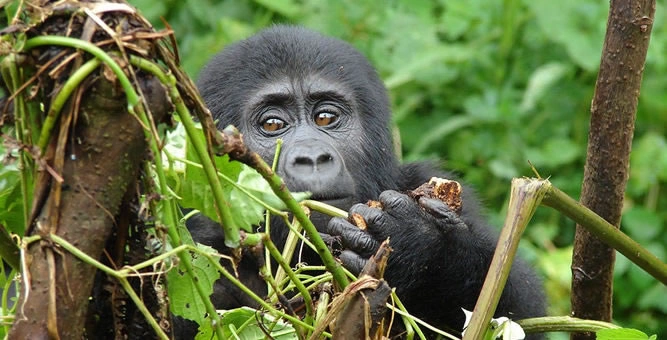
Gorilla Trekking in Mgahinga starting from Kigali
Gorilla trekking in Mgahinga Gorilla National Park starting from Kigali is one of the most convenient and rewarding primate safari experiences in East Africa. Mgahinga, Uganda’s smallest national park, lies in the scenic Virunga Mountains on the southwestern tip of Uganda and offers an intimate, less crowded alternative to Bwindi Impenetrable National Park. Starting the journey from Kigali — Rwanda’s clean, well-organised capital — allows travellers to reach Mgahinga in just three to four hours while passing through some of the most breathtaking highland landscapes in the region.
This safari option is ideal for travellers who prefer shorter driving distances, flexible itineraries, and the opportunity to experience both Rwanda and Uganda in a single trip.
Why Start Gorilla Trekking in Mgahinga from Kigali
Starting from Kigali saves considerable time compared to starting from Kampala or Entebbe. The drive from Kigali to Mgahinga takes approximately three to four hours via the Cyanika border crossing, whereas the journey from Kampala or Entebbe can take nine to ten hours.
Kigali International Airport is well connected with international flights from Europe, North America, the Middle East, and across Africa, making it an excellent entry point for the safari. The roads from Kigali to southwestern Uganda are smooth and scenic, passing through Rwanda’s famous rolling hills, rural communities, and the dramatic volcanic landscapes of the Virunga Massif as you approach the border.
This route also creates natural opportunities to combine the Mgahinga gorilla trek with other enriching experiences — a Kigali city tour and visit to the Genocide Memorial, golden monkey tracking in the bamboo forests, or cultural encounters with communities in both Rwanda and Uganda.
Overview of Mgahinga Gorilla National Park
Mgahinga Gorilla National Park is located in Kisoro District in southwestern Uganda, sharing its borders with Rwanda to the south and the Democratic Republic of Congo to the west. Covering just 33.7 square kilometres, it is Uganda’s smallest national park, but what it lacks in size it more than compensates for in dramatic scenery and remarkable wildlife.
The park forms part of the greater Virunga Conservation Area — a 434-square-kilometre protected zone shared between Uganda, Rwanda, and the DRC — and is dominated by three extinct volcanoes: Mount Muhavura (4,127 metres), Mount Sabyinyo (3,645 metres), and Mount Gahinga (3,474 metres). Bamboo forests on the lower slopes give way to Hagenia woodland, open montane grassland, and volcanic summits, creating diverse habitats for an extraordinary range of wildlife.
The park supports 76 mammal species and over 184 bird species, including several endemic to the East Congo Montane region. It is also one of only two places in the world where the endangered golden monkey can be tracked in the wild — the other being Rwanda’s Volcanoes National Park. For mountain gorillas, Mgahinga is home to a single habituated gorilla group: the celebrated Nyakagezi family.
The Nyakagezi Gorilla Family
The Nyakagezi gorilla family is the only fully habituated gorilla group in Mgahinga Gorilla National Park and one of the most fascinating mountain gorilla families anywhere in East Africa. The family takes its name from an area within the park where it has long been observed spending much of its time, returning consistently to feed, nest, and rest.
What makes the Nyakagezi family particularly remarkable is its social structure. The family has five silverbacks — Bugingo, Mark, Mafia, Rukundo, and Ndugutse — living together in a single family unit, which is exceptionally rare among mountain gorillas. In most gorilla groups, when a dominant silverback is overthrown, he is expelled from the family and lives out his days in isolation. In the Nyakagezi family, this has not happened.
Mark overthrew his own father Bugingo as the dominant silverback, yet Bugingo — now estimated to be over 54 years old — remains peacefully within the family in the honoured role of the elder, what the park rangers affectionately call the Mzee, or old and wise one. Rather than living in exile, Bugingo sits at the heart of the family as a grandfather figure, his presence alongside four other silverbacks creating a social structure that is extraordinarily unusual and deeply compelling to witness. The other family members include the adult females Nyiramwiza and Nshuti, the juvenile Nkanda, and the infants Mutagamba and Rukundo.
Since 2012, the Nyakagezi family has settled more permanently within Mgahinga’s boundaries after years of occasionally crossing into Rwanda and the DRC, and the success rate for finding them on a trek now stands above 95 percent. Because Mgahinga has only one habituated gorilla family, the Uganda Wildlife Authority issues just eight trekking permits per day — making the Mgahinga gorilla experience among the most exclusive and intimate in the country.
Gorilla Trekking Permit Cost
A gorilla trekking permit for Mgahinga Gorilla National Park costs USD 800 per person for foreign non-residents — the same fee as Bwindi Impenetrable National Park. The permit includes park entry, armed ranger guide services throughout the trek, and one hour of observation time with the gorilla family once located. Discounted rates apply for East African citizens and foreign residents of East Africa, according to Uganda Wildlife Authority guidelines.
Permits must be booked in advance through the Uganda Wildlife Authority or through a registered Ugandan tour operator. With only eight permits available per day, Mgahinga’s gorilla trekking fills quickly during peak season — June to September and December to February require booking at least three to six months in advance.
The Gorilla Trekking Experience
Gorilla trekking in Mgahinga begins at the park headquarters at Ntebeko, where registration and briefing by Uganda Wildlife Authority rangers begin at 7:45 AM. Rangers explain the rules of the encounter, introduce the tracking team, and confirm the gorilla family’s current location from tracker radio contact before the group enters the forest at 8:00 AM.
The terrain in Mgahinga is moderately challenging — the volcanic slopes involve some steep sections, and the altitude, which sits between 2,400 and 3,000 metres in the trekking zone, means the air is cool and noticeably thinner than at lower elevations. Porters are available at the trailhead and are strongly recommended, both to assist with carrying packs on steep sections and to provide physical support on the more demanding parts of the trek.
Trek duration varies between thirty minutes and four to six hours, depending on where the gorillas have moved. When the Nyakagezi family is found, visitors are given one hour in their presence. With only eight visitors permitted per day, the atmosphere during this hour is quiet and unhurried — more intimate and personal than many larger gorilla parks allow. The family goes about its morning with remarkable composure: feeding on wild celery and Vernonia leaves, grooming, nursing infants, moving through the vegetation. The five silverbacks, living together in rare and peaceful coexistence, are unlike anything you are likely to see anywhere else in gorilla country. The encounter is emotional, humbling, and unforgettable.
Getting to Mgahinga from Kigali
The most direct route from Kigali to Mgahinga is via the Cyanika border crossing, approximately ninety kilometres northwest of Kigali on the road toward Musanze. After crossing into Uganda, the road continues through Kisoro town — a pleasant highland centre fourteen kilometres from the park gates — to the Ntebeko park headquarters.
The total journey from Kigali to the park headquarters takes three to four hours depending on border processing time, making it one of the most accessible gorilla trekking destinations in East Africa for travellers flying into Rwanda. Travellers should carry a valid passport with the appropriate visas for both Rwanda and Uganda, along with a yellow fever vaccination certificate.
An alternative for those preferring to avoid road travel is a charter flight from Entebbe International Airport or Kajjansi Airfield to Kisoro Airstrip — a one-hour flight with spectacular aerial views of the Rift Valley, Lake Bunyonyi, and the Virunga volcanoes on the approach. Private road transfers in 4×4 safari vehicles are available from Kigali and from Kisoro airstrip to the park.
Best Time to Visit
Gorilla trekking in Mgahinga is possible throughout the year, and the Nyakagezi family is accessible in all seasons. The dry seasons — June to September and December to February — offer the most favourable trekking conditions, with firmer trails, less mud, and the clearest skies for photography. These periods also have the highest demand for permits, so advance booking is essential.
The wet seasons — March to May and October to November — bring lush, intensely green forest, fewer visitors, and lower lodge rates at many properties. The trails are muddier and some steep sections can be slippery, but the gorilla sightings remain excellent and the forest has a vivid, atmospheric quality that many travellers find more dramatic than the dry season.
What to Pack
Practical packing makes a significant difference on the trek. Essential items include:
- Sturdy, ankle-supporting waterproof hiking boots
- Long-sleeved shirts and long trousers in neutral colours
- A waterproof rain jacket
- Garden gloves for gripping vegetation on steep sections
- A hat for open sections of the trek
- A small daypack
- Insect repellent and sunscreen
- A reusable water bottle and light snacks
- A camera with extra batteries or a charged power bank
No flash photography is permitted near the gorillas. A dry bag for camera equipment is advisable, particularly during the wet season. Walking sticks are available at the park headquarters, and porters can be hired at the trailhead for a modest fee that contributes directly to local livelihoods.
Accommodation Options Near Mgahinga
The area around Kisoro and the Mgahinga park boundary offers accommodation across a range of budgets.
Luxury: Mount Gahinga Lodge, situated directly at the park boundary, is the most exclusive option — a small collection of tented suites set in gardens against the volcanic slopes, with exceptional food and guided activities directly from the lodge. Chameleon Hill Lodge, set above Lake Mutanda with uninterrupted views of the Virunga volcanoes, is another outstanding high-end choice combining remarkable scenery with intimate service.
Mid-range: Mutanda Lake Resort, Lake Mulehe Safari Lodge, and the historic Kisoro Travellers Rest — which hosted Dian Fossey and other early gorilla researchers — all offer comfortable accommodation with mountain or lake views at accessible price points.
Budget: Mgahinga Community Camp and a range of guesthouses and small hotels in Kisoro town provide straightforward and affordable options within easy reach of the park.
Combining Mgahinga with Other Experiences
A gorilla trekking safari in Mgahinga starting from Kigali can be extended and enriched with additional activities that make the most of the region.
Golden Monkey Tracking in Mgahinga’s bamboo forest is available on a separate permit and can be done on the morning before or after the gorilla trek. Mgahinga is one of only two places in the world where golden monkeys — brilliantly coloured and endemic to the Virunga Massif — can be observed in the wild. The park is often described as the place where silver meets gold.
Volcano Hiking is one of Mgahinga’s signature experiences. Mount Sabyinyo’s jagged summit ridge sits at the meeting point of Uganda, Rwanda, and the DRC — standing on top places you literally in three countries at once. Mount Muhavura and Mount Gahinga offer full-day hikes with equally spectacular panoramas.
The Batwa Cultural Experience offers a visit to the Batwa people, the original inhabitants of the Virunga forests, whose deep traditional knowledge of the forest’s plants, animals, and ecology provides a human dimension to the park’s conservation story.
Kigali City Tour and Genocide Memorial on the day of arrival or departure adds an important cultural and historical layer to the safari for visitors passing through Rwanda’s capital.
Bwindi Impenetrable National Park is reachable from Mgahinga via Kabale in approximately two to three hours, making it a natural extension for travellers who want to combine two gorilla destinations in one trip.
Lake Bunyonyi and Lake Mutanda — both close to Kisoro — offer scenic lakeside relaxation and rewarding boat trips as a calm conclusion to the more active days in the park.
Gorilla trekking in Mgahinga starting from Kigali is a compelling choice for any traveller who wants an exclusive, intimate gorilla encounter in a setting of dramatic volcanic beauty, without the longer overland journey from Kampala. The Nyakagezi family — with its rare coalition of five silverbacks, its ancient patriarch Bugingo living contentedly alongside the son who succeeded him, and its stable presence within the park since 2012 — is one of the most remarkable gorilla families in the world. The eight-permit daily limit means you will share this encounter with very few other people. And the three-to-four-hour drive from Kigali means the logistics are among the simplest of any gorilla safari in East Africa.
With the volcanic peaks of the Virunga above you, the bamboo forest around you, and a mountain gorilla family going about its morning in the open ground ahead, Mgahinga delivers exactly what it promises: something unforgettable, in a setting unlike anywhere else on earth.
Request for a Quote
Start planning your adventure trip today with a professional expert available to help you 24/7. Encounter Africa on your own terms.
Request a Quote +256 770 514883