- DIRECT CONTACTS:
- +256 704 945229
- info@kaaraadventures.com
Luxury Gorilla Safaris in Bwindi
Deep in the mountains of southwestern Uganda, where the mist sits in the valleys until mid-morning and the ancient trees rise forty metres above a forest floor that has not changed in 25,000 years, Bwindi Impenetrable National Park shelters approximately half the world’s surviving mountain gorilla population. It is one of the most significant wildlife habitats on earth — a UNESCO World Heritage Site that has earned that designation not through administrative convenience but through genuine biological urgency — and a gorilla safari in Bwindi is, for most people who do it, the most extraordinary wildlife experience of their lives.
A luxury gorilla safari in Bwindi takes that experience and removes every logistical friction, every unnecessary discomfort, every distraction between you and the encounter itself. It begins with a chartered flight over the Rift Valley and ends with the silverback disappearing into the undergrowth while you stand in the forest, slightly stunned, wondering how an hour passed that quickly. Between those two moments, everything is arranged with precision, comfort, and the kind of personalised attention that only a small group, a private guide, and a lodge that knows your name before you arrive can provide.
Why Bwindi
Bwindi is not the only place in the world where mountain gorillas can be trekked — Rwanda’s Volcanoes National Park and the DRC’s Virunga National Park share that distinction — but it is the largest and most significant gorilla habitat, the one with the greatest number of habituated gorilla families, and the one that offers the widest range of trekking experiences. Over 20 habituated gorilla families are distributed across four main trekking sectors: Buhoma in the north, Ruhija in the east, Rushaga in the south, and Nkuringo in the southwest. Each sector has its own character, its own landscape, and its own families, and the choice of sector is one of the first decisions in planning a Bwindi safari.
Bwindi’s forest is ancient and dense in a way that very few forests in the world can claim. It survived the ice ages that stripped vegetation from most of sub-Saharan Africa by functioning as a biological refuge in the Albertine Rift’s stable microclimate — and the result, over 25,000 years, is an ecosystem of extraordinary complexity and richness. Over 1,000 plant species. 350 bird species including 23 Albertine Rift endemics. 120 mammal species. And the mountain gorillas, moving through a forest that has been theirs for far longer than it has been protected.
The combination of authentic, uncompromised wilderness and world-class lodge accommodation — lodges positioned at the forest edge, designed to sit within the landscape rather than impose upon it, offering everything that a fine hotel provides while the sounds of the forest come through the window — is what makes Bwindi ideal for a luxury safari. The wilderness is not curated or managed for comfort. The lodges are. And that distinction produces an experience that feels genuine rather than staged.
The Gorilla Trekking Experience
The day of the gorilla trek begins early. Breakfast at the lodge before first light, a short transfer to the park’s sector headquarters, and then the briefing — Uganda Wildlife Authority rangers introducing the specific gorilla family you will be tracking, explaining the rules of the encounter, and confirming the location radio contact with trackers who have been in the forest since before dawn.
The rules are simple and worth understanding before you arrive: maintain seven metres distance from the gorillas at all times; no flash photography; no trekking if you have a respiratory illness; no eating or drinking near the animals; and follow ranger instructions throughout. These are conservation requirements, not formalities — the gorillas’ susceptibility to human respiratory disease is genuine, and the distance rule protects both them and you. Your ranger will enforce them calmly and consistently, and understanding the reasoning behind them makes compliance easy.
Then the trek begins.
Bwindi’s forest is exactly as described — impenetrable in places, demanding in others, and beautiful throughout. The terrain is steep, the undergrowth dense, and the trails occasionally require the use of both hands to manage a descent or scramble through a section of root-tangled hillside. Luxury safaris provide porter assistance as standard — a local porter carries your pack, offers a steadying hand on difficult sections, and allows you to concentrate entirely on the forest around you rather than on managing your own load. Walking sticks are provided at the trailhead. Post-trek refreshments are arranged for your return.
The trek can last anywhere from thirty minutes to six hours, depending on the gorilla family’s position. The trackers’ radio contact and the rangers’ knowledge of each family’s movement patterns keep the uncertainty manageable — your guide will have a good sense of whether you are looking at an hour or three — but the variability is part of what makes the encounter feel real rather than scheduled.
When the gorillas are found, the world changes character.
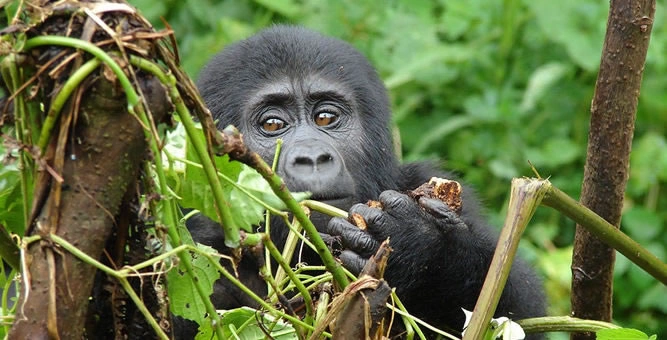
The silverback is usually the first to register — his size, the silver saddle of hair across his back, and the particular weight of presence he carries in the space around him. The family continues its morning: females feed steadily, pulling wild celery with hands of extraordinary precision; infants nurse or play in the vegetation; young gorillas move through the canopy overhead with the unselfconscious athleticism of animals who have never thought about falling. And you stand in the forest with seven other visitors and two rangers, not speaking, watching, the one hour passing with the particular speed that intense attention always produces.
The genetic closeness — approximately 98 percent of shared DNA — is not an abstraction in this moment. It is visible in the expressions, in the way a mother looks at her infant and back at you, in the silverback’s brief direct gaze that contains something you cannot quite name but immediately recognise. When the hour ends and the rangers guide the group away, leaving the gorillas to their morning, the walk back out of the forest carries a silence that most visitors describe as one of the best parts of the day.
The Gorilla Habituation Experience
For travellers who want to go deeper, the Gorilla Habituation Experience is the most exclusive wildlife encounter available in Uganda — and one of the most remarkable wildlife encounters available anywhere.
Rather than one hour with a fully habituated gorilla family, the habituation experience places you with a semi-habituated group — one that is still in the process of growing accustomed to human presence — for up to four hours, alongside the researchers and trackers conducting the habituation work. The experience is more unpredictable than a standard trek, which is precisely what makes it valuable: the gorillas move more naturally, behave more spontaneously, and the extended time in their presence produces an understanding of gorilla social life that one hour cannot fully provide.
The Gorilla Habituation Experience is currently available only in Bwindi’s Rushaga sector. Permits are more expensive than standard trekking permits and more limited in number. For photography enthusiasts, primate researchers, and anyone who has done a standard gorilla trek and wants to go further, it is without question the right choice.
Luxury Lodges in Bwindi
Lodge selection is central to a luxury Bwindi safari. The lodges near Bwindi are not international hotel chains transplanted into a forest setting. They are intimate, carefully designed properties — most with fewer than fifteen rooms — where the design responds to the landscape, the food is made from local ingredients sourced from communities adjacent to the park, and the staff treat you as a guest rather than an occupant. These are the places that set the standard for eco-luxury in East Africa, and they are worth choosing carefully.
Sanctuary Gorilla Forest Camp (Buhoma) sits inside the park boundary — the only lodge with this distinction in Bwindi — which means the forest begins at the edge of your tent and the morning sounds are entirely of the forest rather than of roads or town. Eight luxury tents, each with a private deck overlooking the trees, offer a level of immersion that no lodge outside the boundary can match. Spa services, personalised dining, and direct access to the Buhoma trekking trails make it the most sought-after luxury address in Bwindi.
Bwindi Lodge (Buhoma) commands a spectacular ridge position above the forest, with panoramic views across the canopy toward the Democratic Republic of Congo. Premium bandas with stone fireplaces — the evenings at Bwindi’s altitude are genuinely cold — private outdoor baths, a wellness spa, and a community development programme that employs exclusively from the surrounding villages give it a character that is both luxurious and purposeful.
Nkuringo Bwindi Gorilla Lodge (Nkuringo) occupies one of the most dramatic positions of any lodge in Uganda — on a high ridge above the Nkuringo sector, with views of the Virunga volcanoes on the Rwandan border on clear mornings. The Nkuringo sector is the least crowded of Bwindi’s four sectors, and the lodge’s exclusivity reflects that: fewer guests, more space, a sense of genuine remoteness that the more accessible sectors cannot quite replicate.
Rushaga Gorilla Camp (Rushaga) provides access to the highest concentration of habituated gorilla families in Bwindi — including the families available for the Gorilla Habituation Experience — in a setting of forested hills above the Rushaga valley. Luxury suites with private decks and outdoor showers, attentive and knowledgeable staff, and the proximity to multiple gorilla families make it the best choice for travellers who want to trek on multiple days or experience both standard trekking and the habituation experience.
All of these lodges are committed to eco-tourism principles: solar power, rainwater harvesting, waste management, and community employment are standard practice rather than selling points.
Getting to Bwindi
The most practical and comfortable way to reach Bwindi for a luxury safari is by chartered flight. Entebbe International Airport to Kihihi Airstrip (serving Buhoma and Ruhija sectors) or Kisoro Airstrip (serving Nkuringo and Rushaga sectors) takes approximately one hour, with views of the Rift Valley, Lake George, and the Bwindi forest canopy on the descent that provide a genuinely spectacular introduction to the park. Lodge transfers from the airstrips are arranged in advance and typically take thirty to sixty minutes on roads that have improved significantly in recent years.
Private road transfers from Entebbe or Kampala are the alternative — a journey of seven to nine hours through the green highlands of western Uganda, passing the crater lakes of Fort Portal, the savannah of Queen Elizabeth, and the increasingly dramatic landscapes of the Kigezi highlands. The road journey is long but beautiful, and for travellers combining Bwindi with Queen Elizabeth National Park, it is the natural route between the two.
Permits and Planning
Mountain gorilla trekking permits cost USD 800 per person for foreign non-residents — a fee set by the Uganda Wildlife Authority that covers park entry, ranger guide services, and the one-hour encounter with the gorilla family. The Gorilla Habituation Experience permit costs USD 1,500 per person. Both are non-transferable once issued and must be booked in advance — standard trekking permits in peak season (June to September, December to February) sell out three to six months or more ahead.
Permit booking is handled by your safari operator as part of the itinerary arrangement. Securing the permits before confirming any other element of the safari is the single most important logistical step. All other planning — lodges, flights, transfers, additional activities — builds around the permit date.
Best Time to Visit
Bwindi’s forest is accessible year-round. The dry seasons — June to September and December to February — offer the most comfortable trekking conditions: firmer trails, less mud, and the clearest skies for photography. These months also have the highest lodge rates and the most competition for permits.
The wet seasons — March to May and October to November — bring lush, intensely green forest, dramatically reduced visitor numbers, more competitive lodge pricing, and a quality of light and atmosphere in the forest that many photographers consider superior to the dry season’s clarity. The trekking is more demanding in the mud, and some steep sections require more care, but the gorillas are entirely present and the encounter no less extraordinary. For luxury travellers who value exclusivity and do not mind packing a rain jacket, the wet season offers a genuinely different and in some ways richer experience.
What to Pack
Practical preparation matters on the trek regardless of the comfort of the safari around it. The essentials: sturdy, ankle-supporting waterproof hiking boots (the single most important item); long-sleeved shirts and long trousers in neutral colours; a waterproof jacket; garden gloves for gripping vegetation on steep descents; a small daypack. Bwindi’s altitude means mornings are cool and evenings are genuinely cold — a fleece or warm layer is essential even in the dry season, and a heavier layer for lodge evenings.
For photography: a camera with a zoom lens (200mm minimum), a fast prime or wide-angle for forest interiors, and a dry bag for rain protection. No flash is permitted near the gorillas. Lodge fireplaces and charging points handle battery management, and most lodges provide laundry services that keep the packing list short.
Request for a Quote
Start planning your adventure trip today with a professional expert available to help you 24/7. Encounter Africa on your own terms.
Request a Quote +256 770 514883