- DIRECT CONTACTS:
- +256 704 945229
- info@kaaraadventures.com
Luxury Gorilla Trekking Safaris in Uganda
Uganda is the ultimate destination for travellers seeking an intimate, high-end encounter with mountain gorillas in their natural habitat. Often called the Pearl of Africa, Uganda combines extraordinary primate experiences with refined comfort, exclusive lodges, and personalised service. Luxury gorilla trekking safaris here are designed for discerning travellers who value privacy, authenticity, and seamless travel — without compromising on adventure or the raw, unmediated quality of a genuine wilderness encounter.
From the ancient mist-wrapped forests of Bwindi Impenetrable National Park to the dramatic volcanic landscapes of Mgahinga Gorilla National Park, Uganda offers a setting for gorilla trekking that is both extraordinary and, in the best possible sense, irreplaceable.
Why Choose Uganda for a Luxury Gorilla Safari
Uganda is home to more than half of the world’s remaining mountain gorillas — somewhere over 500 individuals across two national parks — making it the most significant gorilla habitat on earth. What sets Uganda apart for luxury travellers, beyond the sheer density of gorilla families available for trekking, is the quality of the experience around the encounter: the lodges are genuinely excellent, the guides are among the most knowledgeable in East Africa, and certain sectors of Bwindi offer a degree of quietness and exclusivity that is increasingly difficult to find in the region’s more heavily marketed destinations.
Uganda gorilla safaris are ideal for honeymooners, private groups, photographers, and travellers for whom the encounter with an endangered animal in its own ancient forest is the reason for the journey — and who want everything surrounding that encounter to be handled with elegance and precision.
The Gorilla Trekking Experience
A luxury gorilla trekking safari in Uganda begins before the forest, with a private transfer to the sector park headquarters in the early morning. Uganda Wildlife Authority rangers brief the group on the specific gorilla family they will be tracking, explain the rules of the encounter, and confirm the family’s position from tracker radio contact before the trek departs.
The rules are worth understanding before you arrive: maintain seven metres distance from the gorillas at all times; no flash photography; no trekking if you have a respiratory illness; no eating or drinking near the animals. These are conservation requirements, not formalities — gorillas are highly susceptible to human respiratory disease and the protocols protect both the animals and the people in their presence.
The trek through Bwindi’s forest can take anywhere from thirty minutes to six hours, depending on where the gorilla family has moved overnight. The terrain is demanding in places — steep volcanic hillsides, dense undergrowth, root-tangled ground — and porter assistance, included as standard on a properly arranged luxury safari, transforms the experience for most people. With someone else carrying your pack and offering a steadying hand on the difficult sections, your attention is free to be where it belongs: in the forest, reading what is around you.
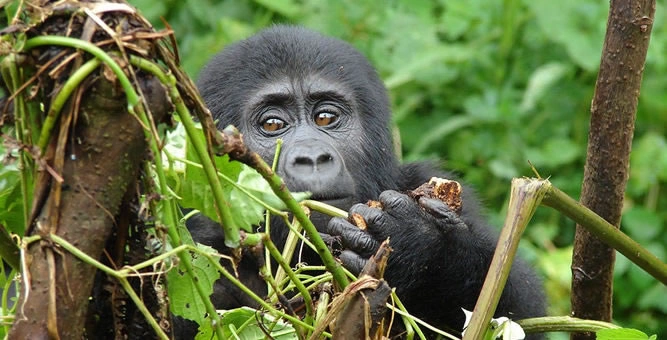
When the gorillas are found, the experience shifts entirely. One hour with a habituated mountain gorilla family — watching them feed on wild celery, groom each other with focused attention, nurse infants, and move through the canopy with a fluid, unhurried confidence — produces the kind of encounter that is genuinely difficult to prepare for. The genetic closeness (approximately 98 percent of shared DNA) is not an abstraction in the moment. It is visible in the faces, in the expressions, in the brief direct gaze of the silverback before he returns to his feeding. When the hour ends and the rangers guide the group away, the walk back out of the forest carries a silence that most visitors describe as one of the best parts of the day.
For travellers who want to go further, the Gorilla Habituation Experience in Bwindi’s Rushaga sector offers up to four hours with a semi-habituated gorilla family alongside the researchers conducting the habituation work — a more unpredictable, more intimate, and ultimately more immersive encounter than a standard trek, and the most exclusive gorilla experience available in Uganda.
Best Destinations for Luxury Gorilla Trekking in Uganda
Bwindi Impenetrable National Park
Bwindi is Uganda’s premier gorilla trekking destination — a 331-square-kilometre UNESCO World Heritage Site in the Albertine Rift that protects approximately half the world’s mountain gorilla population. Over 20 habituated gorilla families are distributed across four main trekking sectors: Buhoma in the north, Ruhija in the east, Rushaga in the south, and Nkuringo in the southwest. Each sector has its own character, landscape, and lodge options, and the choice of sector is one of the most important decisions in planning a Bwindi safari.
Buhoma is the most established sector, with direct access to some of the finest lodges in the park and a well-developed network of trekking trails. Nkuringo sits on a high ridge with views across to the Virunga volcanoes and offers the most dramatic scenery and the most remote feel. Rushaga has the highest concentration of habituated families and is the only sector where the Gorilla Habituation Experience is available. Ruhija, in the highland east of the park, receives the fewest visitors of the four sectors and offers a level of quietness that is its own kind of luxury.
Mgahinga Gorilla National Park
Mgahinga, Uganda’s smallest national park at 33.7 square kilometres, sits in the far southwest against the border of Rwanda and the DRC. Set against the three Virunga volcanoes — Mount Muhavura, Mount Sabyinyo, and Mount Gahinga — it offers a more exclusive trekking environment than Bwindi, with a single habituated gorilla family (the remarkable Nyakagezi group, with its five silverbacks) and just eight trekking permits issued per day. Luxury safaris in Mgahinga typically combine the gorilla trek with golden monkey tracking — one of only two places in the world where this is possible — and cultural encounters with the Batwa community, whose traditional knowledge of the Virunga forest is ancient and extraordinary.
Luxury Accommodation
The lodges and camps near Uganda’s gorilla parks represent some of the finest forest accommodation in Africa. They are not international hotel chains adapted to a remote setting. They are intimate, thoughtfully designed properties — most with fewer than fifteen rooms — where the architecture responds to the landscape, the food is sourced from communities adjacent to the park, and the staff provide the kind of personal, attentive service that a small property with a genuine investment in its guests can offer in a way that larger establishments rarely match.
What high-end Bwindi lodges offer as standard: spacious suites or private cottages with forest views and outdoor decks; fireplaces for the genuinely cold Bwindi evenings at altitude; gourmet dining using fresh local ingredients; spa facilities and wellness programmes; and eco-conscious design — solar power, rainwater harvesting, waste management — that minimises environmental impact while maintaining exceptional comfort. Staying within a short distance of the trekking trailheads eliminates early-morning transfer stress and allows for a properly relaxed start and return.
Transfers and Getting There
Reaching Uganda’s gorilla parks efficiently is one of the defining logistics of a well-arranged luxury safari. The most time-efficient option is a domestic charter flight from Entebbe International Airport to the airstrip nearest your chosen sector: Kihihi Airstrip for Buhoma and Ruhija, Kisoro Airstrip for Nkuringo and Rushaga. The flight takes approximately one hour and provides spectacular aerial views of the Rift Valley, Lake George, and the approach to the Bwindi forest canopy. Lodge transfers from the airstrips are arranged in advance.
Private road transfers in 4×4 safari vehicles with professional driver-guides are the alternative — a journey of seven to nine hours from Entebbe through the highlands of western Uganda, passing the crater lakes of Fort Portal and the savannah of Queen Elizabeth. For travellers combining Bwindi with Queen Elizabeth National Park, the road journey between the two is the natural connecting route and offers rewarding game viewing in transit.
All logistics — flights, border crossings, transfers, permit confirmations, lodge check-ins — are handled in advance and communicated clearly before departure, so that the journey itself requires nothing from you except presence.
Beyond Gorilla Trekking
A gorilla safari in Uganda pairs naturally with the country’s other extraordinary wildlife and cultural experiences, and most travellers choose to build a broader itinerary around the gorilla trek rather than making it the single focus of the trip.
Queen Elizabeth National Park — Uganda’s most biologically diverse protected area — adds the savannah dimension: game drives on the Kasenyi Plains for lions, elephants, buffalo, and Uganda kob; the Kazinga Channel boat cruise with its extraordinary concentration of hippos, Nile crocodiles, and birdlife; and the Ishasha sector’s tree-climbing lions, one of the rarest wildlife behaviours in East Africa. Private boat cruises on the Kazinga Channel can be arranged for groups who want the waterway experience without the shared boat.
Kibale Forest National Park — the Primate Capital of Africa — adds chimpanzee trekking to the itinerary, providing a second great ape encounter that contrasts with the gorilla experience in almost every way: faster, louder, more kinetic, conducted in a different kind of forest at a lower altitude. The contrast between a morning with chimpanzees in Kibale and an afternoon arriving at Bwindi as the mist comes in is one of the best single-day experiences available in Uganda.
Murchison Falls National Park in the north offers the complete savannah and river safari: game drives across open plains for lions, giraffes, and elephants; the boat cruise up the Victoria Nile to the base of the falls, where the entire volume of the Nile squeezes through a six-metre rock gap and drops forty-three metres in a roar that is felt before it is seen; and the northern wilderness feeling that is entirely different from the enclosed rainforest parks of the southwest.
Cultural encounters — visits to local communities around Bwindi and Kibale, the Batwa trail at Mgahinga, an evening at the Ndere Cultural Centre in Kampala — can be arranged through knowledgeable guides who have relationships with community leaders and ensure that visits are respectful, meaningful, and genuinely beneficial to the communities hosting them.
Best Time to Visit
Uganda’s gorilla parks are accessible year-round, and the gorillas can be trekked in every month of the calendar. The practical differences between seasons are worth understanding when planning.
The dry seasons — June to September and December to February — offer the most comfortable trekking conditions: firmer trails, less mud, clearer skies, and the best photographic light. Lodge and permit demand is highest during these months, and advance booking of six months or more is standard for peak season dates.
The wet seasons — March to May and October to November — bring lush, intensely green forest, dramatically reduced visitor numbers, lower lodge rates at many properties, and a quality of light and atmosphere in the forest that many photographers actively prefer. The trails are muddier and some sections more demanding, but the gorillas are as accessible and the encounter as extraordinary. Travellers who value exclusivity and can plan around the logistics of wetter conditions often find the wet season more rewarding than the dry.
Conservation and Responsible Travel
Every gorilla trekking permit purchased in Uganda contributes directly to the conservation system that protects these animals. Permit fees fund Uganda Wildlife Authority ranger teams, anti-poaching patrols, veterinary care for injured gorillas, and community development programmes in the villages surrounding the parks. A portion of revenues is distributed directly to communities adjacent to park boundaries — compensation for wildlife interaction with farmland and a meaningful incentive for local support of conservation over land conversion.
The mountain gorilla population has grown from approximately 620 individuals in 2008 to over 1,000 today. That recovery is a direct result of conservation funding, much of it generated by gorilla tourism. A well-chosen luxury safari amplifies this contribution: the best lodges employ exclusively from local communities, source food from local farmers, invest in surrounding schools and health facilities, and operate with environmental management systems that minimise their footprint on the forest they border.
Choosing a safari operator and lodges with genuine conservation commitments — not just marketing language about sustainability, but verifiable practice — is one of the most important decisions in planning a Uganda gorilla safari, and one of the most meaningful ways a traveller can ensure that their visit leaves the destination better than they found it.
Planning Your Safari
A luxury gorilla trekking safari in Uganda rewards careful, early planning. Gorilla permits are strictly limited — eight visitors per gorilla family per day in Bwindi, eight per day for the single family in Mgahinga — and sell out months in advance during peak season. Securing the permits before confirming lodges, flights, or any other element of the itinerary is the single most important logistical step. Everything else builds around the permit dates.
Beyond permits, the most important decisions are sector choice, lodge selection, and whether to extend the safari to include other parks. An experienced safari specialist who knows Bwindi’s sectors personally — who can tell you why Nkuringo’s ridge position makes it worth the extra road time, or why Rushaga is the right choice if the Gorilla Habituation Experience is on your list — is invaluable in making these choices well.
Uganda offers one of the most extraordinary wildlife encounters available anywhere in the world. The mountain gorilla in its own ancient forest is not a wildlife experience that can be replicated elsewhere, curated into something more convenient, or adequately captured in photographs. It requires your presence, in the forest, for one irreplaceable hour. Everything else — the lodge, the guide, the flight, the porter — is in service of that hour, and a well-planned luxury safari ensures that every one of those elements is worthy of it.
Request for a Quote
Start planning your adventure trip today with a professional expert available to help you 24/7. Encounter Africa on your own terms.
Request a Quote +256 770 514883